How should a B2B SaaS collect reviews?
And why?
Reviews are arguments your customers make for you. For future customers.
Credibility. In B2B nobody buys software because your website looks nice. They buy because someone like them has already tried it and written about it. A review from a real customer carries more weight than three case studies.
Buyer and C-level decision making. Larger deals are never decided by one person. Reviews are what your contact forwards internally when they have to defend the decision to someone who has never seen your product.
Product feedback. This is the most underrated part. In reviews people write things they will not tell you on a call - especially in the “what I dislike” field.
Mass outreach. Every now and then you write to all clients at once. Deliberately all of them, not just the happy ones - otherwise you get a skewed average that nobody will believe anyway. A few three-star ratings look more credible than nothing but fives.
Individual outreach. You pick specific people - high NPS, a recent positive experience, a successful onboarding, a resolved ticket. This is how you keep fresh reviews coming continuously rather than in one wave a year.
You need both. Mass outreach gives you volume and objectivity; individual outreach keeps it current.
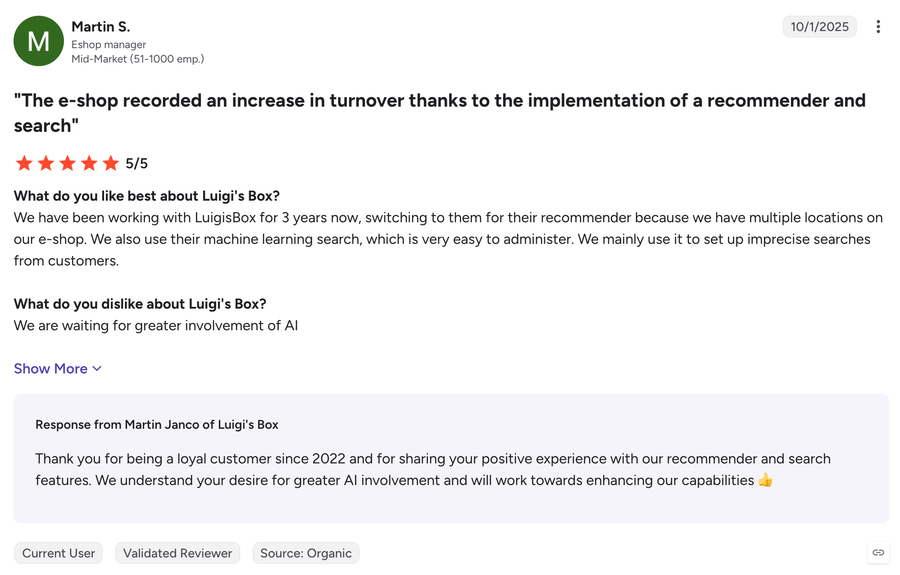
It depends on your target market focus.
If your business is local, collect reviews mainly on local review platforms (e.g. OMR in DACH). Ideally, if you have a profile and integration with local platforms, focus your collection there (e.g. a SaaS targeting the CZ/SK market - Shoptet Doplňky, targeting the PL market - Idosell).
If you target international ecommerce, collect reviews on platforms that operate internationally - G2, Gartner Peer Insights, Capterra, Trustradius, SaaShub, Sourceforge, Trustpilot. Some places approve more reviews than others.
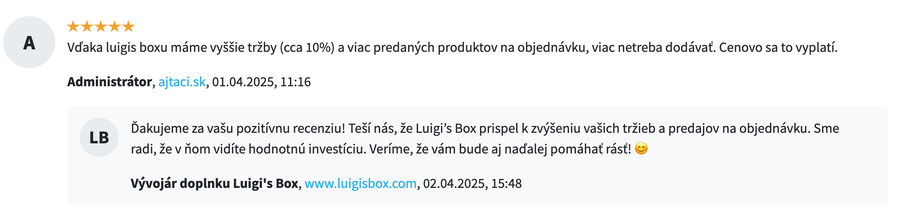
An incentive works because writing a good, substantive B2B review takes 10 to 20 minutes. The recommended level is €20 – 50 in a gift card, depending on the market and how demanding the form is.
Watch out for corporate gift policies. Some people are not allowed to accept a gift, or have to declare it - typically in large corporations, banks, the public sector or regulated industries. Always offer the option to write a review without the incentive, and never make it a condition.
You are rewarding the reviewer’s (the customer’s) time, not the content of the review. Never make the incentive conditional on the rating - besides being unethical, platforms like G2 forbid it and can block your profile.
For Luigi's Box I ran a B2B review collection process - G2 from 160 to 430+ while holding top category positions, Gartner Peer Insights from 7 to 108 and first place in EMEA in the Search & Product Discovery category, and OMR Reviews from zero to 70+.
To deliver the incentives, Luigi's Box used Tango Card, which significantly simplified the admin across countries.
Besides building credibility and trust for future buyers, reviews are also an excellent source of data for your SaaS business.
You can collect data from reviews (positives, negatives) and assess whether it would make business sense to act on that feedback. Sometimes it is small things that bother people, sometimes more complex features for enterprise clients. That is for you to judge.
Do not collect in one burst. A hundred reviews at once and then a year of silence looks worse than a steady flow. Both platforms and buyers look at the dates.
Respond to negative reviews. A polite, factual reply under a three-star rating sells more than ten five-star ones.
Act on the feedback and say so. When someone learns their comment led to a change, they will write you a review next time too.
More on how I help B2B SaaS companies overall on the For SaaS Companies page.